
People who know I write these with AI tend to picture the same thing: I type a topic into a chatbot, it spits out 900 words, I paste them here, done. I understand why, but that’s not the process, and honestly the output of that process is always recognisably hollow. You can feel the absence of a person in it.
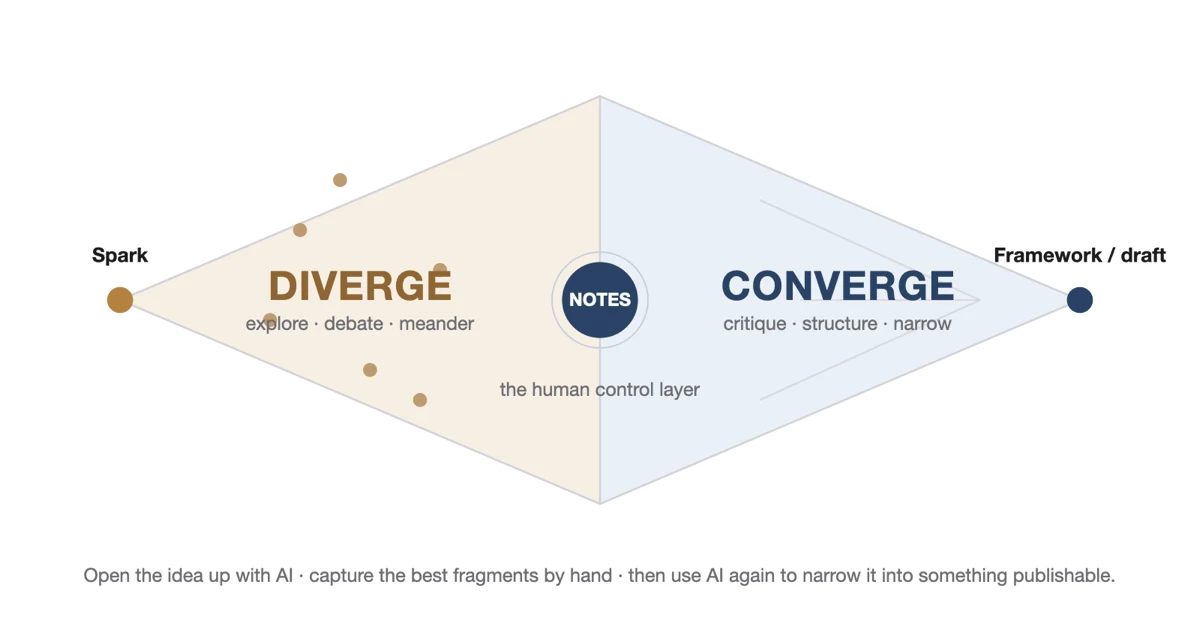
The whole loop on one diagram. The notes sit at the pivot: the one part of the process the model never gets to own.
Here’s the honest version. The blank page has never been my problem. The half-formed idea is. I usually have a hunch, a frustration, or an opinion I can’t quite defend yet. What I need isn’t a writer, it’s a thinking partner who will take that hunch somewhere and then help me work out whether it survives contact with scrutiny.
So I don’t open by asking for prose. I open by arguing. And this article, fittingly, was written exactly the way it describes.
It starts with a spark, not a brief
Every post begins as something small and slightly annoying: a claim I keep hearing that feels wrong, a pattern I’ve seen three times but never named, a question I can’t stop turning over. That’s the spark. At this stage I have no thesis and no structure, and crucially, I don’t try to manufacture one. Reaching for the outline too early is how you end up confidently writing the wrong article.
Mode one, divergence: using AI to open the idea up
The first long stretch of the conversation is deliberately inefficient. I give the model a premise or an opinion and ask it to push on it, extend it, connect it to things I wouldn’t have reached for. I’ll say “argue this for me,” or “what’s the strongest version of this idea,” or “take this somewhere strange.” Then we meander, and when we hit something juicy we deep-dive instead of moving on.
When I wrote about the future of AI and jobs marketplaces, this divergent phase ran for ages. We explored agents applying and negotiating on a jobseeker’s behalf, hirers automating sourcing and screening, marketplaces being hollowed out by agent-to-agent hiring, and the new forms of trust and verification that might emerge in response. None of that was a plan. It was the model opening doors faster than I could on my own, which is exactly what divergence is for.
It isn’t only analytical, either. Naming a private “context workspace” app I’d been sketching, the same expansive mode threw out copilot-style names, command-centre metaphors, memory-and-signal metaphors, until Nexus landed, because it captured scattered context converging into one place. Sometimes AI is most useful as a foil for taste: language, metaphor, aesthetic direction. The human still decides what feels right.
The notes are the control layer
Here’s the step most people skip, and it’s the one that makes the whole thing work. Every time the conversation says something genuinely interesting (a phrase, a distinction, a sharp counter-example) I copy it, by hand, into a note. (I use Bear for this. Bear, if you’re reading: the sponsorship inbox is open.)
That manual copy is not laziness-avoidance; it’s the control layer. The notes are the fragments that I, not the model, decided were worth keeping. If I let the AI summarise the conversation later, it decides what mattered, and it will smooth my best, weirdest, most personal observations into the same agreeable paste as everything else. The notes are how I keep my judgement in the loop instead of outsourcing it.
Mode two, convergence: using AI to argue and narrow
Once the idea has sprawled, I flip the model’s job entirely. Now I want a sceptic. Disagree with me. Argue the opposite. Find the assumption this whole thing rests on and kick it.
That adversarial turn is where the jobs-marketplace piece actually got good. Asking for the opposing view (why might this not happen?) narrowed a dramatic forecast into something more durable: hiring is social, emotional and regulated, so it changes slowly; incumbents hold power through trust and distribution; the safest bets aren’t single predictions but capabilities that stay useful across scenarios.
Convergence is also where a messy distinction becomes a thesis you can say in one breath. A long ramble about whether AI is “trustworthy” eventually compressed into a single line (use LLMs where ambiguity is the input; use deterministic systems where correctness is the output) and that line became the spine of an entire post on probabilistic AI versus deterministic systems. I didn’t write that sentence first and decorate it. I argued my way down to it.
Critique prompts are at least as important as generation prompts. The model is a fluent optimist by default; you have to ask it to be a good adversary.
From mess to framework, and not always an article
The output of convergence isn’t always a blog post. The same loop (expand, capture, challenge, structure) produces whatever the idea actually wanted to become.
Sometimes it’s a technical spec. A loose idea about discovering small-business websites and extracting their job listings expanded into crawling strategy, deduplication, change-monitoring and a data model, then converged into a disciplined spec-driven document a coding agent could build from: the kind of groundwork behind mybizopz, my SMB venture. Sometimes it’s a brief: I once used months of accumulated conversation to assemble a structured brief for a personal site, then handed that brief to another agent to design and build robertalford.com. That is a second-order use of AI, where the artefact is context for the next AI. And sometimes it’s the framework itself, like the “Product AI Harness” idea: structured context, roles, evaluation and feedback loops around a model, rather than a cleverer prompt.
Then, and only then, the draft
Only now do I ask for a draft, and I point it explicitly at the notes and the discussion, not at the topic. By this stage the article is half-written in my head; the model is assembling an argument I’ve already shaped, not inventing one. That difference is everything.
Then I annotate, ruthlessly. What’s true, what feels off, what’s superfluous, what’s missing, where it sounds like a brochure instead of like me. The model produces another draft. We repeat. It usually takes a few passes before it stops reading like competent AI prose and starts reading like my thinking. That last gap is the whole job.
The whole thing is a harness
The meta-point is the same one I keep arriving at from every direction: the value isn’t the model, it’s the system you build around it. This writing process is itself a small AI harness:
Spark → meander → capture → challenge → converge → draft → annotate → iterate → queue.
And the human owns the parts that matter most: the taste, the judgement, the manual notes, and the final yes. I use AI as a thinking environment. I wander around an idea until something sharp appears, then I use AI again to help turn that sharp thing into structure.
Only once a piece feels clear, useful, and personally endorsed does it go into the publish queue. The honest tell: if a draft reads like it could have been written about anyone, by anyone, it failed the loop, and it doesn’t ship.