
Ten years ago I spent a week in a room with eleven other people and a wall of butcher’s paper, and we deliberately broke almost every rule in the design-sprint playbook.
It worked. That’s the uncomfortable part.
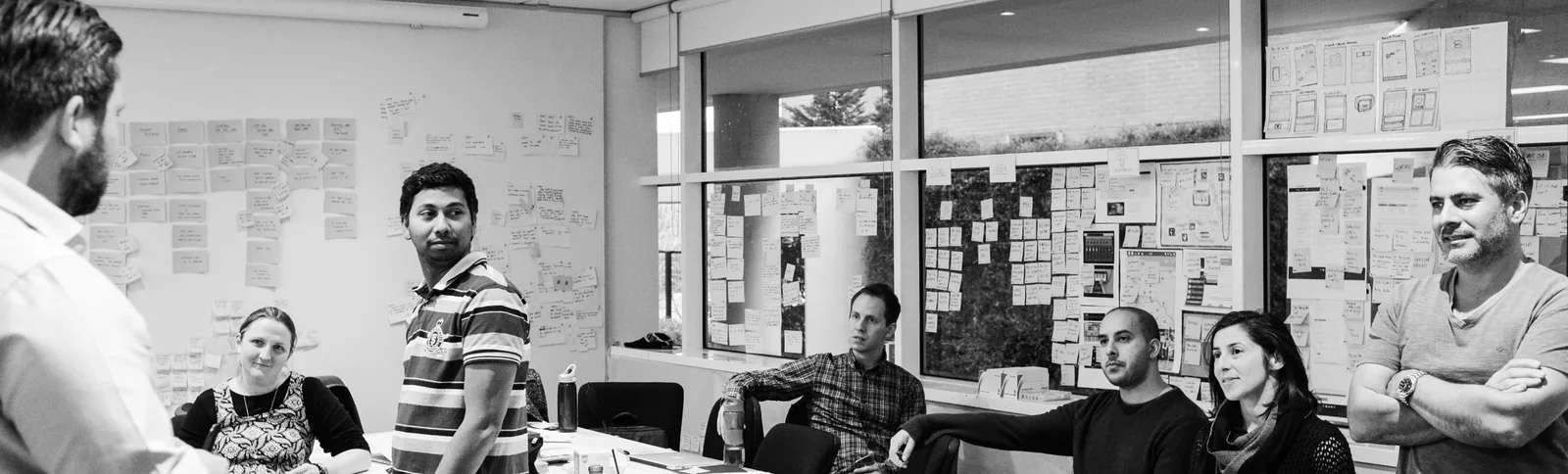
The sprint team: twelve people from across the business, one room, one week. “Cross-functional” isn’t a nice-to-have here. It’s the whole mechanism.
Since then I’ve watched the design sprint go from a Google Ventures curiosity to a fixture on every product team’s wall planner. And I’ve watched most of them run the same way: a tidy, de-risked, by-the-book five days that produces a tidy, de-risked, by-the-book outcome. A polished prototype of an idea everyone had more or less already agreed on.
Which is fine. It’s just not innovation.
A sprint that only confirms what you walked in believing isn’t a sprint. It’s a very expensive offsite.
This is the story of one that did the opposite, and a field guide to the parts that actually drove the innovation, so you can steal them.
The opportunity nobody owned
It started with a gap. We’d identified a market segment that wasn’t well served by us, or, more interestingly, by any of our competitors. And critically, it wasn’t on anyone’s roadmap.
That last detail matters more than it looks. Roadmaps are where ideas go to calcify. Once something is on the plan, it accretes momentum, owners, and sunk cost, and the organisation quietly stops asking whether it’s still the right thing. The genuinely new opportunities are the ones with no owner, no slide, and no champion, which is exactly why they never get worked on.
We suspected the best answer would be a real departure from what we did today. Radical, not progressive. The kind of thing you can’t incrementally A/B test your way towards. So we asked a simple question:
What’s the fastest way to generate genuinely novel ideas (and kill the bad ones) before we’ve spent a quarter building the wrong one?
The answer was to lock a cross-functional team in a room for a week and force the issue.
Innovation is a practice, not an event
Here’s the mindset shift that makes the rest of this make sense.
Most organisations treat innovation as something that happens to them: a flash of inspiration, a visionary founder, a lucky bet. So they wait for it. And waiting, predictably, produces very little.
The teams that actually innovate treat it as a muscle. Something you train under constraint, on a schedule, with reps. A design sprint is one of the best pieces of innovation equipment ever invented precisely because it manufactures the conditions that inspiration is supposed to need (focus, diversity, pressure, and fast contact with reality) and does it on demand.
Innovation is something you practise, not something that comes for free.
The sprint isn’t the innovation. The sprint is the gym.
Set the table before you cook
The single biggest predictor of whether a sprint works is decided before it starts. Get these ingredients wrong and no amount of clever facilitation saves you.
A deadline you cannot move
The best thing we did was pre-schedule real users to come in and test, before we had anything to show them. Knowing twelve strangers were walking through the door at 1pm on Wednesday gave the whole team a brutal, non-negotiable goal: have something on paper, or stand there with nothing.
That’s a forcing function, and forcing functions are how you manufacture focus. It short-circuited the usual debate cycle. Differences of opinion that would normally consume a fortnight of meetings got resolved in twenty minutes, because the alternative was public embarrassment in front of a user.
We added a second one at the end: a 3pm Friday presentation to the executive team. Bookend your sprint with two immovable deadlines and the week runs itself.
The whole business in one room
Our team was twelve people: product managers, developers, a marketing comms manager, strategy, designers, a sales lead, a researcher, and a business analyst.
That breadth is not decoration. Innovation lives at the seams between functions: the place where what’s desirable meets what’s feasible meets what’s viable. A room of designers will produce beautiful designs. A room of engineers will produce clever architecture. A room with all of them, arguing, produces things none of them would have reached alone.
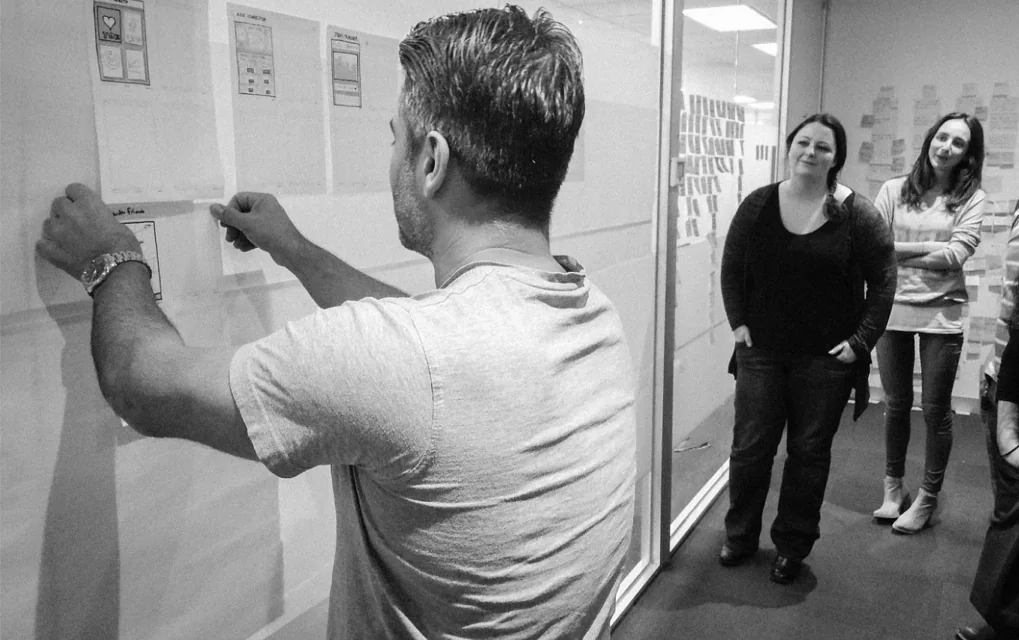
Make your thinking visible. By day one the walls were vanishing under paper, and everything stayed up all week, so we could keep arguing with our day-one selves.
A facilitator you didn’t pick from your own team
If you cut a corner somewhere, cut it on the snacks. Do not cut it here.
A design sprint can fail with a great team and a weak facilitator, and succeed with an average team and a great one. You want someone who has done it before, who is genuinely impartial, and who can keep a dozen opinionated people motivated and on-track for a week. That almost always means someone external. They have no stake in whose idea wins, which is the entire job. Ours came from outside the company, and it was the best money we spent.
Walls, paper, and pens
You will need more wall space than you think. A lot more.
Plaster the walls with butcher’s paper so you can draw on it and stick notes to it at the same time. Get Sharpies and grey Copic markers (more on those in a moment). And (this is the rule people break) leave everything up, all week. The wall becomes the team’s external memory. On day five you’ll be reaching back to a scrap you scribbled on day one, and you’ll be grateful it’s still there.
Where we broke the playbook
Now the heretical part. We followed the Google Ventures structure closely, and then deviated in four deliberate ways. Each deviation, in hindsight, is where the actual innovation came from.
The standard playbook            What we did instead
─────────────────────            ───────────────────
Test once, on day 5          →   Tested from day 3, four sessions
Converge, THEN prototype     →   Tested multiple ideas, THEN converged
Five days, hard stop         →   Seven days when it mattered
Executive votes weigh more   →   Every vote weighed exactly the same
1. We tested early, and often. The book says test on day five. We put real users in front of rough paper prototypes on day three, and ran four sessions over two days. Feedback that would normally arrive after the sprint arrived in the middle of it, while we could still act on it.
2. We tested multiple ideas before converging, not after. This is the big one. The standard sequence is converge on one idea, then test it. We inverted it: we kept several competing ideas alive and let users help us choose between them. That meant we brought users into the act of creation rather than using them as a late-stage rubber stamp.
Converging early feels like progress. Usually it’s just the moment you stopped considering the idea that would have won.
3. We extended past five days. Testing more meant we needed two extra days the following week to build higher-fidelity prototypes and test those too. Five days is a long time to pull twelve people off their jobs. But having gone that far, compromising the outcome to protect an arbitrary boundary would have been madness.
4. We gave nobody a bigger vote. The playbook suggests certain people (the “Decider”) get weightier votes. We made every vote equal. In our culture that was the right call, and the effect was striking: people put forward bolder, weirder, more divergent ideas because no one was reading the room for the boss’s preference first.
The fastest way to kill divergent thinking is to let everyone see where the power wants it to land.
The meta-lesson: the playbook is a starting point, not scripture. Learn it cold, then adapt it to your problem, your team, and your culture, on purpose, not by accident.
The week, day by day
Day 1: Unpack, don’t present
We walked in with a staggering amount of material: a fresh Jobs-To-Be-Done analysis, years of user research, opportunity gaps, personas. The obvious risk was death by PowerPoint.
So our facilitator banned it. As homework, everyone prepared two two-minute talks (one on a competitor, one on something that simply inspired them) with no slides. While each person spoke, rotating note-takers played back what they’d heard.
It’s a small trick that does four things at once: everyone knows they’ll be presenting, so everyone prepares; everyone has to take notes, so everyone pays attention; the competitor reviews drag the whole room into the opportunity space; and the “what inspires you” prompt quietly gives the team permission to think in blue sky. We reached day two with genuinely compatible views of the problem, not a slide deck nobody remembered.
Day 2: Resist the urge to sketch
By day two everyone is itching to draw. You’ve understood the problem; the natural instinct is to start solving it. The book even encourages sketching on day two.
We didn’t. We spent the entire day getting inside our users’ heads instead: journey maps, empathy maps, light-weight personas for both the businesses and the individuals we were designing for.
It is the most skippable-feeling step and one of the most valuable. Not everyone arrives understanding what it’s like to be in your user’s shoes, and the motivations and fears we surfaced shaped every debate for the rest of the week. We kept referring back to those personas, and kept challenging and correcting them as real users walked in.
Empathy is the step everyone wants to skip and the one that separates a novel idea from a self-indulgent one.
Day 3: How might we, then pens down
Only now did we sketch, and only after turning our maps into sharp, specific problem statements through a “How might we…” exercise. General curiosity makes for bad sketches; a precise problem makes for good ones. We grouped and prioritised the problems, and each small team grabbed one card and started drawing solutions.
But first, a five-minute exercise that punches far above its weight: we learned to draw.
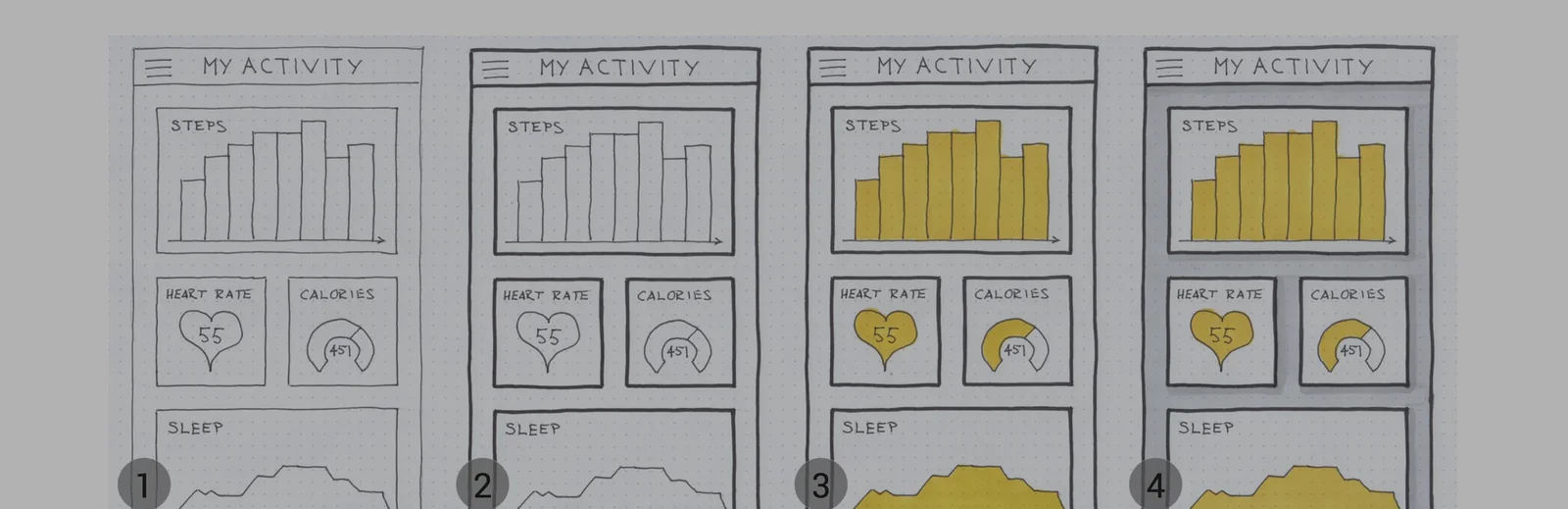
The “learn to draw” trick: outline in fine-liner, thicken the structure with a Sharpie, highlight what matters with one colour, then shade the background grey so the foreground jumps. Four steps, and a room of non-designers produces sketches a user can actually read.
The recipe is exactly that simple:
- Draw the interface in a thin fine-liner.
- Trace the main structural elements with a thicker Sharpie.
- Highlight the most important elements with a single coloured Copic marker.
- Wash the background in light grey so the foreground pops.
It gave everyone (engineers, sales, finance) the confidence that they could draw, and it meant that when twelve different hands presented sketches to users, they all shared one coherent visual language.
At 1pm, the first users arrived. Every fear that paper prototypes were “too rough” evaporated within minutes. People engaged with the scribbles immediately and gave us richer feedback than any polished mock-up would have. We also made sure everyone got to run a feedback session, not just the trained researchers, so the whole team built empathy first-hand instead of receiving it second-hand in a readout.
Day 4: Diverge again
The temptation on day four is to refine yesterday’s ideas and start narrowing. We did the opposite: we picked fresh “How might we” cards and attacked new parts of the problem, armed with what we’d learned the day before.
It opened the thinking right up. The best fragments of day-three ideas got recombined into genuinely new day-four solutions. Then two more groups of users came in. By the end we had more ideas to choose from, not fewer, which is the entire point of the diverge phase.
Day 5: Converge
With feedback from a dozen users papering the walls, we finally let ourselves narrow. Having every idea still pinned up made it easy: we could point at exactly what users had loved and loathed, and assemble a single, coherent product concept from the strongest parts.
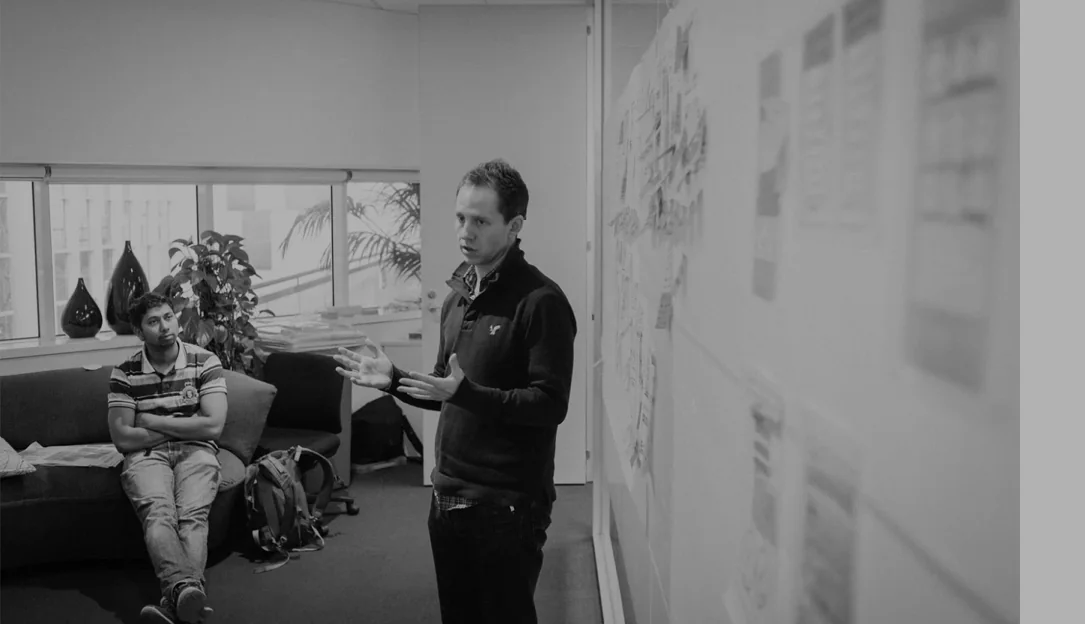
Day five. With a dozen users’ worth of feedback on the walls, converging on one idea was the easy part, because we’d earned the right to.
This is why converging last works. By day five the decision is half-made for you by the evidence. Converge on day one and you’re just defending a hunch.
Days 6 & 7: Prototype, then go to them
Two designers locked themselves away and built high-fidelity prototypes (one in Sketch and Marvel, one in Axure) loaded onto real phones. With the extra time, the detail work was almost mechanical; we’d already answered the hard questions.
Then we did the thing most sprints never do. Instead of inviting users to us, we split into pairs, put the prototypes in our pockets, and went out to find users unannounced, in their own environment, at their place of work.
Scheduling a user to visit you is an invitation to be polite. Turning up in their world is an invitation to be honest.
The difference is everything. People who agreed to come in are primed to like you; some won’t give negative feedback to save your feelings. People you approach cold, mid-workday, with no relationship to protect, will tell you your idea is rubbish, which is the single most valuable sentence in product discovery. Guerrilla testing is uncomfortable by design, and that discomfort is where the truth lives.
What actually drove the innovation
Strip away the Post-its and the marker pens, and a handful of principles did the real work. These are the parts to steal:
- Manufacture pressure. Pre-booked users and a fixed exec deadline turned a vague “innovation week” into a machine with a hard stop. Constraints don’t limit creativity; they’re the thing that focuses it.
- Diverge longer than is comfortable. The instinct to converge is strong and usually premature. Protect the divergent phase like it’s the asset it is.
- Let users create with you, not only grade you. Testing multiple rough ideas early turns research from a verdict into a collaboration.
- Flatten the power gradient. Equal votes and a neutral facilitator surface bolder ideas, because nobody’s hedging towards the boss.
- Make thinking cheap and visible. Paper, pens, and walls keep the whole team’s reasoning in the open and the cost of changing your mind near zero.
- Go to your users. Comfort is the enemy of honest feedback. Engineer situations where people can reject you.
Weak ideas survive in organisations because no one creates the conditions to kill them quickly. A good sprint is a controlled environment for killing bad ideas fast, and protecting the rare good one long enough to recognise it.
Ten years on
It would be easy to assume a decade has dated all of this. AI can now generate a hundred interface variations before you’ve capped your first Sharpie; a working prototype is a prompt away, not two days of Axure.
But notice what the tools accelerate and what they don’t. They make producing options almost free. They don’t make you choose a problem worth solving, or build empathy for the person who has it, or sit in the discomfort of a stranger telling you you’re wrong. If anything, when generating ten plausible directions is trivial, the disciplines that separate them (divergence, empathy, and honest contact with reality) become more valuable, not less.
That’s the through-line. A design sprint was never really about the five days or the marker pens. It’s a forcing function for the human judgement that no roadmap, and no model, will make for you.
The most exhilarating, exhausting, genuinely creative week of work most of us had ever done came from treating innovation as something you practise (under constraint, in a room, together) rather than something you wait for.
Book the room. Book the users. Break the playbook on purpose.
And converge last.